
Whole-Home Solar Backup Kit Guide (2026): Portable, Battery, and 5kW Tiers
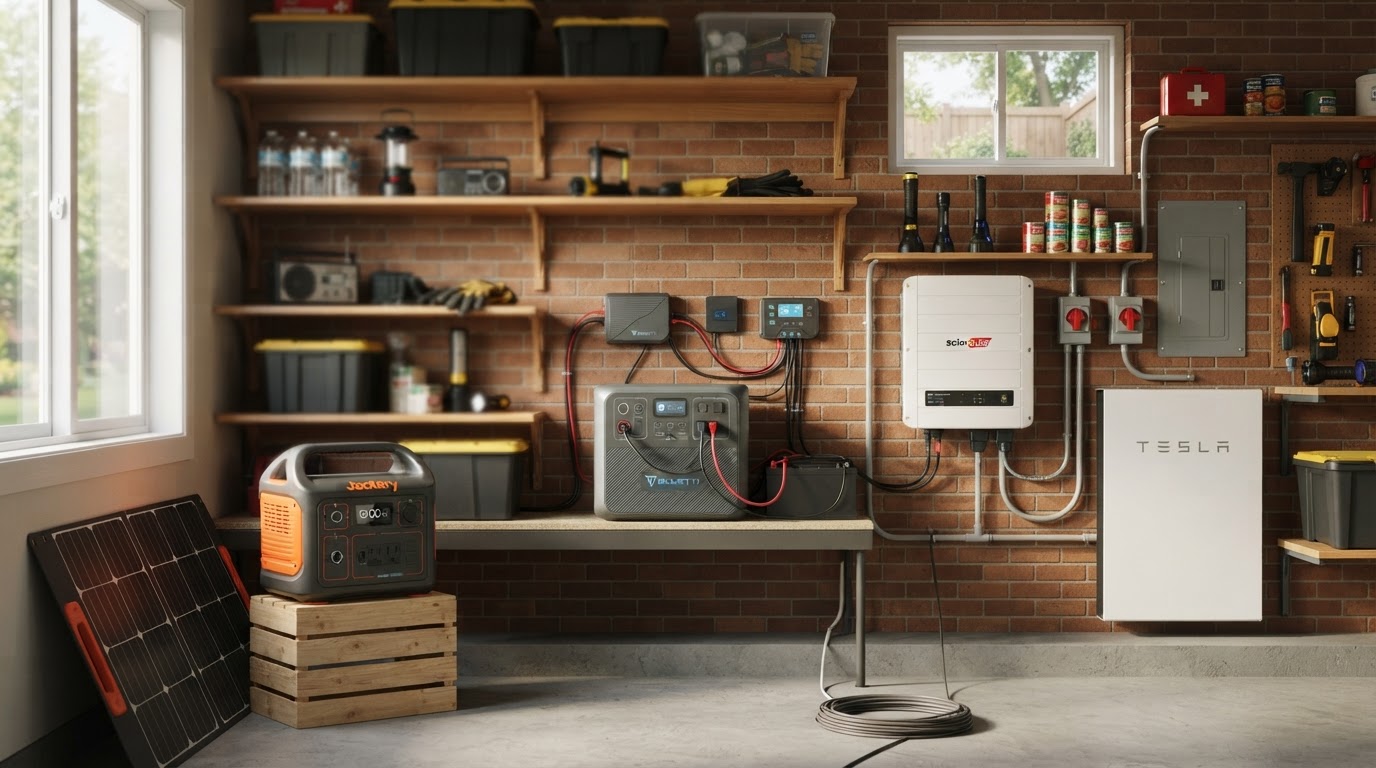
A whole-home solar backup kit runs from a $259 panel up to a $3,100 grid-tied 5kW system. Here is how the tiers stack and what each one actually powers.
This article contains affiliate links. If you buy through these links, we may earn a small commission at no extra cost to you.
A whole-home solar backup kit is really three tiers stacked together, and most buyers stop at the first one. A $259 folding panel keeps a EcoFlow RIVER 3 Portable Power Station topped up for phones and a CPAP. A $1,000 battery-and-inverter combo runs the fridge and a few outlets for a day. A 5kW grid-tied kit with battery storage like the ECO-WORTHY 5KW Off Grid Solar System Complete Kit powers the whole house for as long as the sun is up, but it costs about $3,100 and asks for a real installation. Pick the tier that matches the outage you actually get, not the one that sounds the most impressive.
Tier 1: Panel + Portable Station
This is the entry point most people should start at. A 110W folding panel like the EF EcoFlow 110W Portable Solar Panel paired with a 245Wh station covers a single bedroom for a day: phone charging, a CPAP overnight, a router and modem, a few LED lights, and a laptop. It does not run the fridge, the well pump, or anything with a heating element.
The math is honest. A 110W panel refills a 245Wh station in about 3 hours at full output in ideal sun, and a full day once clouds and panel angles eat into that. So you get one full recharge per sunny day, which is enough if your outages last a few hours or you can stretch the load with a headlamp and a hand-crank radio. Read our portable power station guide for the capacity math and our fridge runtime article for the cold chain side.
The strength of this tier is that nothing needs to be installed. Set the panel in the sun, plug the station into it, and move on. The weakness is that anything bigger than a mini fridge is out of reach. If your plan is "keep the fridge going for three days," this tier is not enough.
Tier 2: Battery Combo With Inverter ($600 to $1,500)
The next step up adds a larger battery bank (usually 1 to 2 kWh) and a 1,000 to 2,000W pure sine-wave inverter, which means the fridge, a chest freezer, internet gear, and lights can all run together for most of a day. Some setups in this range are portable power stations at the 1 to 2 kWh scale, and the EcoFlow DELTA 3 Portable Power Station, 1024Wh is the larger sibling of the RIVER 3 at 1,024Wh and 1,800W for about $599. Others are purpose-built lithium battery banks paired with a separate inverter.
This tier is the right answer for the household that loses power two or three times a year for 12 to 36 hours and wants the fridge to stay cold without buying gasoline. The math gets tighter: a full-size fridge pulls 150 to 300W when its compressor cycles on, and a 1 kWh battery bank runs the compressor for roughly 4 to 6 hours of actual draw, which sounds short until you remember the fridge only runs about a third of the time. Net result, a 1 kWh bank keeps a modern fridge cold for most of a 24-hour outage. Add 1 kWh and you stretch that to 36 to 48 hours.
Charging here is the weak point. A single 110W panel refills 1 kWh in about 6 to 8 hours of decent sun, and most of these setups accept two or three panels in parallel, which cuts that to 2 to 3 hours. That is fine if the outage is short, but it is not a long-haul answer if the weather is cloudy for a week.
Tier 3: Grid-Tied Whole-Home 5kW ($3,000 to $5,000)
This is the kit where solar stops being a backup and starts being part of the house. A 5kW grid-tied kit like the ECO-WORTHY 5KW Off Grid Solar System Complete Kit ships with a 2,340W panel array (12 panels at 195W), a 48V 5kW inverter, and a 51.2V 100Ah server-rack LiFePO4 battery (about 5 kWh of storage). It runs the whole house during a sunny outage, charges the battery bank during the day, and discharges it at night. Add a second battery and you double the night-time runtime.
The 5kW class is sized for a typical US home's essential loads: fridge, freezer, well pump, internet, lights, microwave, and a window AC unit on low. It will not back up a central air conditioner or an electric range. For those, you need a 10kW or larger system or a gas generator. Read our home generator guide for the hybrid approach.
What this tier costs you is installation complexity. Twelve panels on the roof or in a ground array, a battery rack in the garage, an inverter wired into your breaker panel, and a permit in many jurisdictions. Most homeowners hire a solar installer for the wiring, even if they mount the panels themselves. The 5kW ECO-WORTHY kit is sold as a complete bundle, which means everything is matched and the wiring diagrams are included, but it is still a project.
Picking the Right Tier
Match the tier to the outage:
- Two to four short outages a year, mostly at night: Tier 1 ($259 panel plus the station's current price).
- Day-long outages a few times a year, fridge matters: Tier 2 ($600 to $1,500).
- Multi-day outages in wildfire or hurricane country, whole-house backup: Tier 3 ($3,000 to $5,000 installed).
Most households do not need Tier 3. If you want to start there anyway, our day-five-without-power article walks through what actually mattered after a long outage, and our cook-without-power article covers the part solar cannot do, which is cooking safely indoors without the grid. Solar is one layer of the answer, not the whole answer.