
When the Power Goes Out and You Depend on Medical Equipment
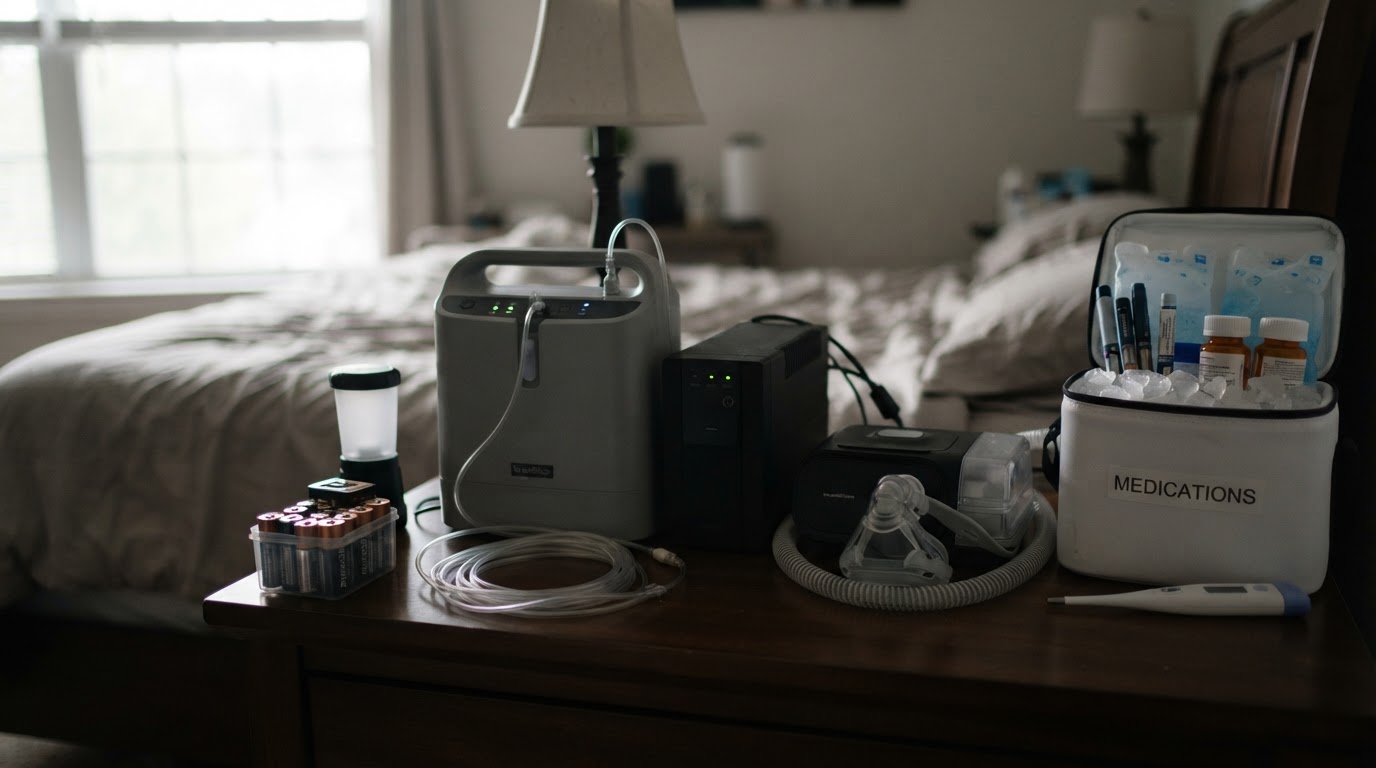
A power outage is a medical event when you depend on oxygen, a CPAP, dialysis, or refrigerated medicine. The plan: registration, tested batteries, cold chain.
This article contains affiliate links. If you buy through these links, we may earn a small commission at no extra cost to you.
Most blackout advice assumes the only things at stake are food, light, and a charged phone. If someone in your house depends on a concentrator, a ventilator, a CPAP, or dialysis, the outage starts a different clock.
Quick answer: Write down every powered device and what it draws. Register with your electric utility and fire department; FDA's disaster guidance tells you to make both calls. Arrange a tested backup for each essential device, keep refrigerated medicine in range, and treat a life-sustaining device failure as a 911 call, not a wait-and-see.
List the devices before you buy anything
The inventory is the same everywhere: oxygen concentrator, CPAP or BiPAP, ventilator, home dialysis machine, infusion or feeding pump, suction unit, nebulizer, power wheelchair or lift, and any monitor that alarms. Record the model, the watts on the label, the measured runtime on backup power, and the supplier's emergency number; tape the list by the outlet.
FDA's disaster guidance says to get one answer from the manufacturer: whether the device can run on batteries or a generator.
Three calls, one afternoon
1. Your electric utility. Many utilities keep a medical baseline or life-support registry; PG&E's Medical Baseline Program in California is one example, and enrollment usually needs a doctor's signature. It buys a lower-cost baseline and advance outage notice, not faster restoration. FDA guidance also says to notify the electric company and fire department that someone at the address uses a device that needs power.
2. Your fire department and local emergency management. FDA advises that if you depend on a device to keep you alive, seek emergency services immediately in a crisis and, when possible, notify your local public health authority before severe weather so evacuation can be planned. Medical-needs registries are the practical version of that, but they never guarantee rescue; the family plan stands alone.
3. The device supplier. Ask what backup the supplier provides during an outage and how after-hours support works. Know this before you ask: Medicare does not pay separately for backup equipment, per Noridian's DMEPOS guidance, so a backup device is something you arrange, not something that arrives by default. For oxygen, ask for written emergency instructions and keep them with the machine.
The battery math that sizes your plan
Runtime is one division: battery watt-hours divided by device watts, minus losses. Manufacturers' battery guides typically figure 10 to 20 percent lost to the inverter, so budget for it and test the exact setup. A plan you have not run is a guess.
Home oxygen concentrators commonly draw 300 to 600 watts depending on model and flow setting, per manufacturer specifications; your unit's label matters most. A 245Wh station like the EcoFlow RIVER 3 Portable Power Station gives a concentrator well under an hour after losses. CPAP machines vary more: the heated humidifier and heated tube are the biggest draws, and with both off, a mid-size station can often carry a full night; your machine's manual has the real figure.
If the load is beyond batteries, such as a ventilator or a full dialysis cycle, the answer is a generator: outside only, at least 20 feet from the house, exhaust pointed away, never in a garage or basement (CPSC). Pair it with a CO alarm on every floor. The portable power station guide covers sizing, and generator CO safety covers placement.
Refrigerated medicine: insulin, biologics, and the clock
When the compressor stops, the clock starts. FoodSafety.gov puts food safe for about four hours in a closed refrigerator; medicines follow their own labeled ranges, often stricter ones. Have two documents ready: the package insert for each refrigerated medicine, and FDA's emergency guidance for insulin, which says many vials and cartridges can stay between 59°F and 86°F for up to 28 days. Products differ, so the insert wins. Never freeze insulin, and keep it off direct contact with frozen gel packs.
Build the cold chain before you need it: a cooler with reusable gel packs like the Cooler Shock Reusable Ice Packs, Gray, 2 Pack holds temperature while you decide on a bigger move; a fridge thermometer with an alarm like the AcuRite Wireless Fridge and Freezer Thermometer… tells you when the range is crossed; and an evaporative wallet like the FRIO Insulin Cooling Wallet, Individual carries pens and vials through an evacuation without power or ice. The prescription supply guide covers storage and refills.
Dialysis and treatments that cannot wait
Dialysis is the clearest case where the plan is logistics, not batteries. National Kidney Foundation emergency guidance: call your center when an event is forecast to find out what is open; keep the names and phone numbers of backup units and hospitals; and if transportation is the problem, contact police or EMS and say you need to reach treatment.
If treatments are missed, NKF's emergency meal plan takes over. It is deliberately stricter than a normal kidney diet: fluid limited to two cups, or 16 ounces, per day; protein cut to about half; no salt or salt substitutes; high-potassium foods avoided. The point is keeping potassium, phosphorus, urea, and fluid from building to dangerous levels; keep a printed copy with your food supplies. FDA adds one more for home dialysis: dialyzers and IV pumps need safe water, so use bottled, boiled, or treated water until the supply is confirmed safe.
During the outage: the escalation rules
- A life-sustaining device that stops is a 911 call. FDA's guidance is direct: if you depend on the device to keep you alive, seek emergency services immediately.
- Move before the battery dies, not after. Relocate the person and device to a powered location while everything still works. The family communication plan is how everyone knows the destination.
- No open flames around oxygen. FDA advises battery-powered flashlights and lanterns rather than gas lights, candles, or torches when oxygen is in use.
- Watch the generator's exhaust. Carbon monoxide is the failure mode that catches careful people.
When the power comes back
Two checks from FDA guidance: verify device settings, because many reset to a default mode when power is interrupted, and check cords and devices for water damage before plugging anything back in. Then recharge every battery and note what ran out.
For the caregiver side, including medication organizers and the neighbor check-in tree, see the elderly parents emergency plan. The power outage survival guide covers the rest of the household's outage needs.
Source notes: FDA, "Tips about Medical Devices and Natural Disasters"; Noridian Medicare DMEPOS guidance on backup equipment; National Kidney Foundation emergency planning for dialysis patients; FoodSafety.gov refrigerator guidance; CPSC generator safety guidance; PG&E Medical Baseline Program; device manufacturer documentation.
Frequently asked questions
How long will a power station run an oxygen concentrator?
Most home concentrators draw 300 to 600 watts depending on the model and flow setting, so check the label on your unit. A 245Wh station covers well under an hour after conversion losses: useful for handoffs and phone charging, not a night of therapy. For overnight support, use the backup tanks or battery your oxygen supplier provides, and test the exact setup before an outage, not during one.
What should I do first when the power goes out and someone uses medical equipment?
Switch each essential device to its planned backup and confirm that any life-sustaining device is still running. Start the clock on the medication fridge at the same time. If a life-sustaining device cannot run, treat it as an emergency: call 911 and move the person to a powered location instead of waiting for the grid.
How do I keep insulin cold during an outage?
FDA emergency guidance says many insulin vials and cartridges can stay between 59°F and 86°F for up to 28 days, but products differ, so the package insert wins. Use a cooler with gel packs and a fridge thermometer to watch the range, never freeze insulin, and use an evaporative cooling wallet for travel or evacuation.